Some of the most treasured items in Dunollie’s textile collection were photographed by specialist museum photographer Jim Dunn, to create these moving images.
The reproduction dress made by High School pupils as part of the Cobalt Blue project is included, along with the original Victorian gown from the collections which inspired it.
Admiral John’s Tartan Suit
Tartan suit made for Admiral Sir John MacDougall, 25th Chief of Clan MacDougall, for the occasion of King George V’s visit to Edinburgh in 1822. A similar suit was made by the same Edinburgh tailor for the King himself.
Known as the ‘King’s Jaunt’, three weeks of pageantry and grand receptions celebrated the first visit of a monarch to Scotland for 171 years. At this time, John held the rank of ‘Master and Commander’, and was titled ‘Younger of Dunollie’, which means heir to the Chief.
In 1826 his father Patrick died and John became Chief. John’s naval career was in the ascent; he was promoted to Rear Admiral in 1857, nominated for a KCB in 1862 and then made Vice Admiral in 1863.
The suit is made of the bright tartan now known as the Heritage MacDougall, in ‘hard tartan’, a much closer and firmer weave than the tartans of today.
The suit comprises five pieces:
- Trews – a slim fitting trouser-like garment with fitted ‘feet’.
- Kilt – different from a modern buckle kilt, this kilt fastens with buttons
- Waistcoat – a short waistcoat with a black cotton backing.
- Coat – Tailored with extraordinary attention to pattern matching. The high velvet collar is embroidered with thistles in silver-gilt thread.
- Plaid – In the portrait of Admiral John which hangs in the Main House, Admiral John wears a shoulder plaid of Heritage MacDougall tartan, held in place with the great Brooch of Lorn.
As well as the garments, a pair of stylised ‘cuarans’, a traditional type of soft leather, sometimes deer hide, cut out shoe worn by Highlanders, was made from fine brown leather to be worn with the trews.
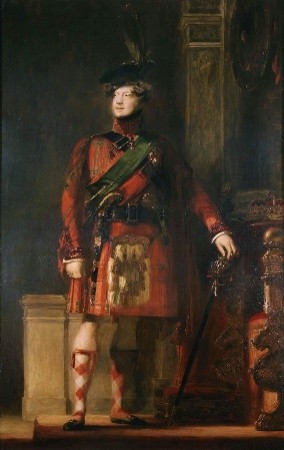
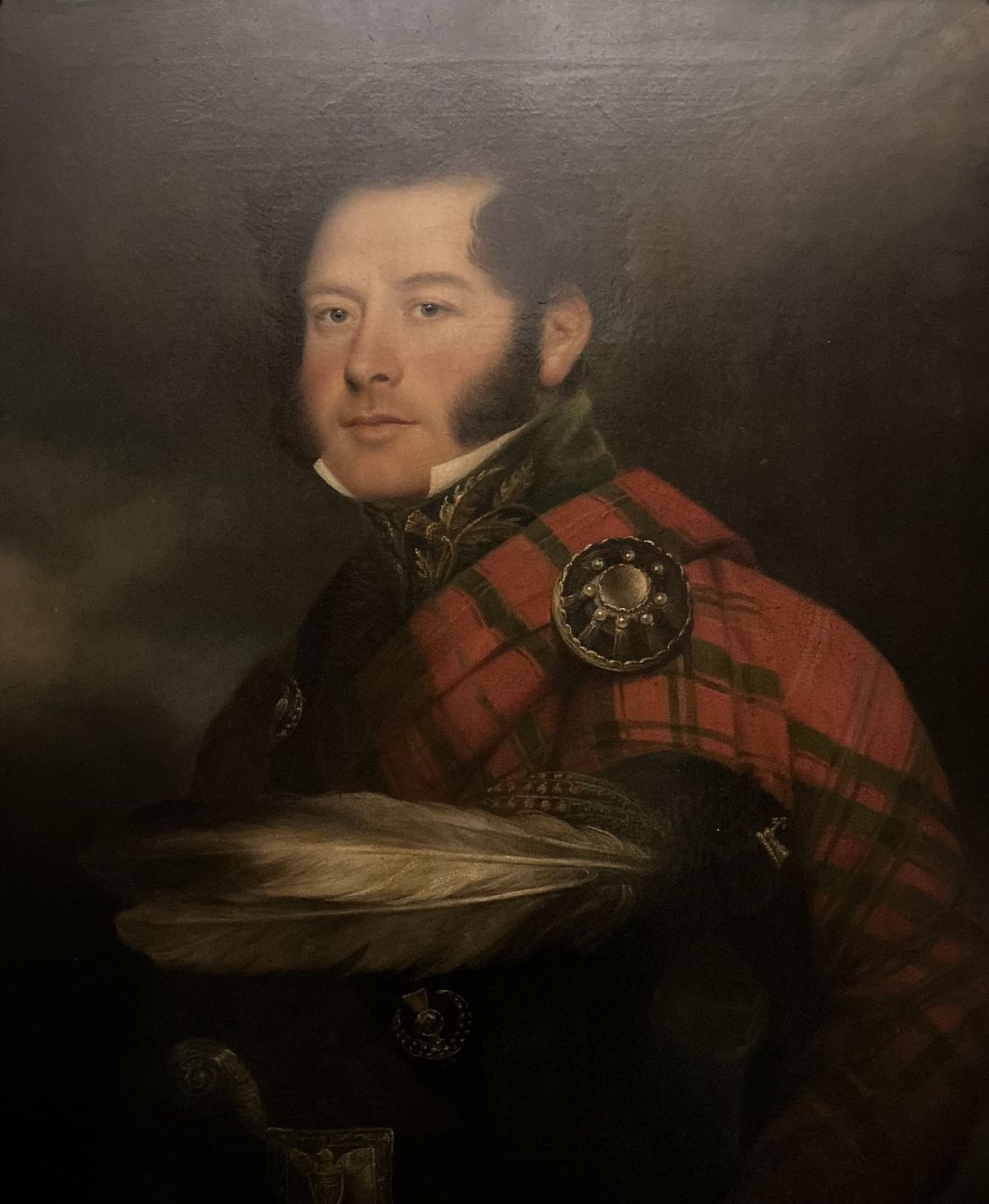
Fig. 1: King George IV on the occasion of his visit to Edinburgh in 1822. Painted in 1829 by Sir David Wilkie. Oils on canvas. Royal Collections Trust. Image: Wikimedia Commons.
Fig. 2: Admiral Sir John MacDougall, 25th Chief of Clan MacDougall, wearing his tartan suit with the great Brooch of Lorn. He holds his bonnet adorned with three eagle feathers, as is customary for a Clan Chief even today. This image is shown with the kind permission of the MacDougall family.
The Beetlewing Dress
Mary Jane MacDougall, sister of John, accompanied her brother to the levée at Holyrood House, Edinburgh, held for King George IV in 1822. Like the tartan suit, her dress was made specially for the occasion according to the dress code requested by Sir Walter Scott. Gentlemen were to be “all plaided and plumed in their tartan array” whereas the ladies were asked to wear ‘a leading dress of white’ with more discreet use of tartan.
John wrote to his father: “Mary has been at the Drawing Room and the Ball and has been kissed by his Majesty which she is very proud of. I received His Majesty with a guard of forty Highlanders at Holyrood Palace.”
The dress, like the suit, is handsewn, as sewing machines did not come into common use until the second half of the 19th century. Its design represents the height of late Regency fashion; the waistline is still high while the skirts are a slim, flared column with fullness gathered at the back.
It is made of silk satin, with a bobbinet lace overlay on the sleeves and at the hem. Fine silk MacDougall tartan edges the sleeves. A pair of dancing slippers covered with the same tartan silk is in the Dunollie collections.
Embellishments and trimming of real beetle wings, known as ‘elytra’ enhance the gown and complement the tartan. Colonial expansion in the Indian subcontinent meant that ‘exotic’ goods like this were being imported into Britain.
The iridescent green beetle wings would have danced in the candlelight at the glittering events of the King’s Jaunt.
The Natural Form Dress
Consisting of a bodice and separate skirt.
Huge bustles at the rear of women’s dresses had replaced hoop skirts by 1870 and remained in fashion until 1890.
The Natural Form era of fashion occurred from approximately 1877 to 1882, in between the Early Bustle and Late Bustle eras. It is characterized by a slimmer silhouette, vertical lines, and elaborate self-fabric swags and furls, often swirling assymetrically around the skirts.
This dress is made of deep cobalt blue silk faille (a medium weight silk woven with a ribbed weave). Skilled placement of baleen (whalebone) was used to create some of the asymmetric shapes of the skirts.
Despite its quite elaborate design, this is nevertheless a day dress, which would be called a ‘visiting’ or ‘afternoon’ gown – in other words, it was intended for stylish socializing rather than wearing at home.
The Cobalt Blue dress
This mid-19th century gown was altered in 1948 by Jean Hadfield, grandmother of current Clan Chief Robin MacDougall.
It is made of vivid blue silk moiré, with a white cotton muslin lining. The bodice is boned with baleen, also known as ‘whalebone’. This is a misnomer, as baleen is actually a fibrous material from the whale’s mouth which filters plankton from sea water. It was used extensively for corsets and gowns throughout the 19th century.
In a pocket was found a dance card from the Argyllshire Gathering ball, 1948. Jean had reserved almost all of the dances for her husband, Dr. Stephen Hadfield. Traditional Scottish Country dances such as the Eightsome Reel and the Gay Gordons feature alongside waltzes and foxtrots.
Its simple short sleeves and self-colour along with the gothic lines of the bodice centre front point and the single, sweeping darts are all characteristic of this period. The gown dates from the late 1840’s – early 1850’s, and pre-dates the crinoline cage, which became available in 1856, and so its skirts would have been supported by numerous cumbersome petticoats. The gown was likely dyed with Prussian Blue, a dyestuff invented in 1704 by Johann Diesbach.
The Cobalt Blue project dress, 2026
Sewn with mis-matched blue fabrics, this dress is the result of a project to re-create the original cobalt blue silk gown from Dunollie.
Oban High School pupils Katie Donnelly, Uist Lennon-Woomble and Hannah Erskine worked with Flora Swietlicki (education officer with the Sophy and White project) over several months to produce this unique garment.
Made from second-hand textiles donated by the public, the dress was sewn entirely without electricity, using both handsewing and an antique Singer treadle machine. New skills were learned by all participants throughout the construction process.
The project team aimed to recreate the gown as its original Victorian version in terms of design and construction, while using 21st century materials.
One of the skirt panels was designed by Uist Lennon-Woomble, using images of the original Dunollie Cobalt Gown under microscopy printed onto cotton sateen.
As an artwork, the dress highlights current concerns about sustainability and the impact of fast fashion. Growing public awareness is leading to more re-use, re-purposing and re-sale of used clothing.
Iterations of the Dunollie cobalt gown now span three centuries – its original 1850’s form, its 1940’s altered style, and its new 2026 version.
With grateful thanks to The National Lottery Heritage Fund for making this project possible.