Category: Collections

  • Sophy & White: April Update

    Sophy & White: April Update

    In January this year, we were finally able to kick off a project that we have been planning for so long now – Sophy & White: The Dunollie Collections Unboxed. This project aims to review our two distinct collections, ensure their security, and maximise their impact by allowing new and wider audiences to engage with them.

    Since starting on the project in January, we have been focused on recruiting volunteers and planning the first of our projects: Scottish Women Collectors: a Sharing Stories event.

    We hosted a volunteer open day on Wednesday 20th March, and we were thrilled to meet 15 people throughout the day, which far exceeded our expectations. A few were involved with Dunollie already, or had been in the past, though many were new faces who had only visited Dunollie or not been at all. It was wonderful to see so many people keen to learn about and help us care for our collections here. We visited our storerooms, showed off some of our favourite pieces – in the hope they would encourage everyone to commit to volunteering, of course! – and then spent some lovely time on the terrace getting to know each other. At the end of the day, everyone who had visited said they would love to be involved, so it was a resounding success!

    We didn’t want to wait too long to get everyone together again, so a fortnight later we invited everyone to come on one of the guided tours here at Dunollie, to learn a little more about the history of the site and the Clan MacDougall. There was a great turnout for this, and it was another lovely afternoon of sharing stories about Dunollie and its gems.

    This week, we are getting underway with some object handling training, generously provided by Catriona, the curator at Glencoe Folk Museum. Next week we will move onto textiles, with training delivered by Jayne Mulqueen, Dunollie Trustee, volunteer and textile expert. Once our volunteers feel confident that this training has given them a basic understanding of working with collections, they will begin coming in for two hours per week, and we can’t wait!

    We have also started preparations for the first of our projects, inspired by Hope MacDougall’s collection and focusing on other Scottish women collectors and historians. Hope’s social history collection resides here at Dunollie under the care of the MacDougall of Dunollie Preservation Trust, and serves as the inspiration for this event. Hope dedicated her life to her passion, which was documenting the social history of Scotland’s highlands and islands, and she amassed a 5,000+ object strong collection, and significant related archive.

    Our hopes for this event, to be hosted on Saturday, September 7th at the Rockfield Centre in Oban, include speakers on a range of topics including traditional textile and craft production, Scottish women collectors and historians, fishing and agriculture communities and more. We have already begun receiving some abstracts for papers – if you would like to submit one, please do so to anna@dunollie.org – the above topics are not exclusive!

    We will also be joined by Deborah Gray, an Oban textile artist, who will be facilitating a natural dye demonstration for interested visitors to check out. Deborah has been teaching spinning, natural dyeing and knitting in Scotland for over 30 years, as well as working abroad. Check out her website: Deborah Gray Textile Artist & Tutor | handspinning, knitting, dyeing (deborahgraytextiles.co.uk) 

    This event may see other practitioners joining us too, so watch this space! Tickets for the event – which will be free to enter – will be promoted on Dunollie’s website and social media channels once everything has been finalised, most likely towards the end of the summer.

    The first few months of this project have been busy but wonderful, and we can’t wait to see what comes next, now that we have our volunteers involved and are underway with the Scottish Women’s Collectors event. Keep an eye on our social media for updates!

    Anna & Shannen 😊

  • Oban Spring Clean – A History

    Oban Spring Clean – A History

    Hope MacDougall’s appreciation of Oban and Scotland as whole is evident in her vast collection of both physical and photographed farming equipment, fishing nets, landscapes, and individuals. But did you know that she founded the first ever “Oban Spring Clean” in March of 1979?

    Along with the Department of Environmental Health, MacDougall sprung to action to combat what the Oban Times recognized as a “litter-bound” city in the late 1970s. She involved local residents in doing so, including Oban youth groups like Oban Youth Club, Scouts, and schools. Together, they mapped different areas of the city that were in special need of assistance, including the railway embankment at Soroba and the local swimming pool. Once mapped, different groups were assigned target places to clean over the course of a week; the Scouts took the pool area whereas the youth club tackled the waterfront. The Oban Times also promoted that anyone autonomous from an organized group could retrieve trash bags from the Tourist Information Office.

    With Hope MacDougall’s inspiration, throughout the last week of March 1979, a honed effort was made to void the city of litter. Fortunately, her efforts sparked further conversation around the environment in Oban, evident in a letter to the editor, in which a writer expresses their concern over the longevity of their work: “But will it last?” (Oban Times 1979). The writer later answers their own question in the same piece: “But the real answer could actually be in the hands of every Oban resident” (Oban Times 1979). This resident called upon their neighbors to push the movement beyond Hope MacDougall’s designated week by taking individual responsibility to maintain cleanliness. Instead of spending a week cleaning litter, do not litter to begin with!

    Similarly, in another article in the local paper, shopkeepers were called upon to remind patrons to dispose of their wrappers in a trash bin, and for the government to hire more street cleaners and garbage collectors. Without Hope MacDougall’s institution of “Oban Spring Clean,” this conversation may not have been initiated.

    In addition to inspiring individuals and businesses to take measures to maintain cleanliness beyond the last week of March 1979, she also sought to inspire future generations to make the clear streets truly last. To do so, she instituted a competition amongst local youth to write essays, poems, and slogans promoting the health of the environment through anti-litter rhetoric. Kirsteen McKellar’s winning slogan read “A mother dog looks after her litter so why can’t you?”. This competition also highlights Hope MacDougall’s interests: she was both a lover of the Oban environment and the arts.

    Hope MacDougall’s efforts clearly had an impact at the time and on the future of Oban, evident in the 1980 Oban Spring Clean the following year, recorded in the Dunollie Archives, and the fact that this tradition has continued to this day. In fact, the 2024 Oban Spring Clean is starting this week on Saturday 23rd March!

    This blog post was written by Helen Anderson who did some great work in our archive this summer, thanks to the MacDougall McCallum Heritage Foundation’s Scholarship and using documents which can be found in the Miss H. MacDougall’s Community Activities, etc. binder in the Dunollie Archives located in the 1745 House Museum’s Reading Room at Dunollie Museum, Castle and Grounds.

  • Sophy & White: The Dunollie Collections Unboxed

    Sophy & White: The Dunollie Collections Unboxed

    We are starting the new year with a bang! This January marks the beginning of a new project for us called ‘Sophy & White: The Dunollie Collections Unboxed’, which was made possible thanks to funding from the National Lottery Heritage Fund.

    ‘Sophy’ and ’White’ are two of the rooms situated in Dunollie House which make up their museum storeroom facilities. ‘Sophy’ is home to 3,000 items of clan and family dress and textiles dating from 1620 to early 20th century. These objects have been largely locked down since their discovery in 2002 for the safety of the objects. ‘White’ houses the Hope MacDougall Collection gathered in the latter half of the 20th century to record the working and domestic life in Argyll and across the Highlands and Islands. The objects were collected to Hope’s private ‘museum’ in her home – Ganavan House, Oban, from 1966 until her death in 1998, by which time she had over 5,000 objects supported by archive and background material.

    Sophy & White: The Dunollie Collections Unboxed is a project aiming to safeguard, contextualise, and maximise the impact of these extensive collections by auditing, reviewing, recording, and making them accessible to wider audiences. It will engage new participants, facilitate creativity, and provide new skills for the community through the delivery of a four dynamic collections development projects covering themes such as Scottish women collectors, changing agricultural methods and traditions, fashion and textiles and sustainability. This has been our dream as a museum for many years and, thanks to national lottery players, we are finally able to make it come true.

    We are delighted to have welcomed two new members of staff to join our team and lead this 30-month project: Shannen Provan-Sloan is our new Collections Development Officer and Anna Bain our new Engagement and Learning Officer.

    “I am so excited to have been offered the opportunity to work on this project. Throughout my time at Dunollie I have developed such a passion for our collections, and I can’t wait to take these next steps in getting them the recognition they deserve. I think people are going to be so excited by some of the things we have here!”

    -Shannen

    ‘’I am thrilled to have joined the team at Dunollie and be working on the Sophy and White Project. I am most excited about getting the community involved in the project, offering them the chance to learn fascinating new skills and the opportunity to learn about our heritage through our volunteer program. With the help from the public, we can uncover these collections and finally showcase them.’’

    – Anna

    We are looking for a team of volunteers to help Anna and Shannen in their work with our clan, textile and social history collections currently hidden away in Sophy and White.  We would love to hear from anyone with an interest in the project, all ages and levels of experience are welcome. Volunteers will have the opportunity gain various skills through a series of formal training sessions including handling objects, photographing, digital recording, research, interpretation, design, and display, coached by our own staff at Dunollie and by external experts. In turn, they will be able to put these new skills to use in a practical way as Dunollie’s two forgotten collections are brought back into the spotlight.

    If you are interested in volunteering as part of the Sophy & White Team, please let us know by emailing info@dunollie.org .

  • International Clan MacDougall Gathering 2024

    International Clan MacDougall Gathering 2024

    The next Clan Gathering is fast approaching! For those of you who don’t know, Clan MacDougall’s next international gathering is taking place here, in Dunollie, from Tuesday 30th July until Sunday 4th August.

    Information about tickets:

    If you are planning on attending, you should have booked a registration ticket by now. If you haven’t it’s not too late, and you can do so from our website by clicking on the button below.

    We recommend registering before Tuesday 16th January, 10a.m. Scotland time.

    You will need your registration tickets to book activities and events to fill each of your gathering days. Our tickets are going live on the morning of Tuesday 16th January, and will be bookable through the same page of our website as the registration tickets. Acitivity tickets will be accessible through the button above, or, in the following way from our website homepage: On the menu at the top of the page, select ‘Visit’, then from the drop-down menu, select ‘Tickets’. This will redirect you to our ticketing website. There, select ‘Tickets’ and then, ‘Clan MacDougall Gathering 2024’ .

    As we are hosting almost 30 events and most of these run several times, the list may look slightly overwhelming to a new user. To make the booking process as easy as possible, we recommend you familiarise yourself with the activities on offer in advance. Please click on the button below to see our event programme, containing our most up to date list of events, a short description of what each of them entails, as well as each activities’ ticket price and the time and place at which to meet to take part.

    This should help you start to think about what you would like your gathering week to look like and save you some time in the booking process.

    If you are worried about events overlapping, please check the location or meeting point for each of them. You can use google maps to get an estimate of how long it might take to get from one point to another. Please note that some events are meant to overlap. For example, on Saturday 3rd August, you may wish to attend Dunollie’s Living History Day which takes place from 10am-4pm. On that day, it will still be possible for you to attend a 15-minute genealogy consultation session with Caroline Boswell and Edward Sweeney’s talk: ‘Genetic Roots and Branch of the Clan MacDougall – Could you be a blood descendant of Dougall MacSomhairle, King of the Hebrides?’.

    If you are worried an event you really wanted to go to has sold out, please email info@dunollie.org. Spaces for each activity will be allocated on a first booked first served basis, however, in some instance, if there is sufficient demand we may be able to add an extra session.

    If you are attending with children and unsure about what activities are best for them, please rest assured there will be additional kids activities taking place on the week. Children are welcome to attend all adult events, except for some of the informal pub socials in the evenings. In some but not all instances we may be able to offer them a slightly discounted rate, as you’ll see. Details of activities aimed at children specifically will be announced closer to the time.

    If you are unsure about anything, please email info@dunollie.org and Florence or Fee will do their best to advise you.

    Left: Fee Shaw, our Gathering Coordinator | Right: Florence Medard, our Marketing and Coomunications Coordinator.

    Information about Clan Merchandise:

    We are delighted to be offering a new selection of Clan Merchandise specifically designed for the 2024 Gathering. These include T-shirts and Hoodies in a range of sizes and colours, proudly bearing our Gathering logo inspired by Ian Ciar MacDougall’s famous Jacobite Targe. We are also offering black hats, featuring one of the targe’s more intricate designs – the wolf.

    These can be pre-ordered through our shop – The Draper’s Shop – website: www.thedrapersshop.org or by clicking on the button below.

    Please note, Gathering Merchandise will only be available through pre-orders. It won’t be possible to buy t-shirts, hoodies or hats spontaneously at the Gathering. Instead, you can choose to either collect it upon arrival on the morning of Tuesday 30th July or have your order delivered to your address prior to that. If you would like your Gathering Merchandise delivered to your address, you must place your order before Monday 26th February. If you would to collect it during the Gathering, you must place your order by Monday 6th May, at the latest.

    Thank you for reading!

    If you have any questions, let us know by emailing info@dunollie.org and a member of our team will get back to you. We are all very much looking forward to welcoming you to Dunollie this summer.

  • Oban War Efforts during World War 1

    Oban War Efforts during World War 1

    Throughout the First World War, the people of Oban worked tirelessly, like many other people around the world, to help the war effort in any way they could. Though there are likely countless examples of local heroism, the Dunollie archive holds evidence of collection drives for two unlikely materials which made a big impact through these years: eggs, and sphagnum moss.


    On April 14th, 1917, Madeline R. MacLeod of Oban wrote a letter to the editor of Oban Times on behalf of the Director of the War Dressings Supply, requesting parcels of sphagnum moss. Sphagnum moss, which tends to grow in wet places like peat bogs and moorlands, was unsurprisingly in plentiful supply in the Scottish highlands. It had also been found to absorb liquids at three times the speed of cotton gauze, retained fluids better, was cooler and softer, and could be produced more rapidly and at less of a cost. This made it an incredibly valuable resource in a war which seen ever increasing numbers of wounded. MacLeod indicated that the winter had been difficult, and their supply was “exhausted,” offering to receive whatever quantity of moss – large or small – at a Depot in Oban, where she would then send the it on to depleted hospitals. This cutting from the Oban Times was found in the archive boxes belonging to the Hope MacDougall Collection at Dunollie.


    Admirably, it seems that plenty of moss was collected from the local areas, and sent onwards. MacLeod and her band of moss collectors, however, were not the only Oban residents caring for the wounded at a distance: Colina MacDougall, Lady of Dunollie and wife to the Clan Chief of the time, campaigned tirelessly to gather eggs to send to local and international hospitals. Like Mrs. MacLeod gathering and sending moss, Colina wrote in the Oban Times that eggs dispatched to Dunollie would be sent on to Scottish hospitals and those abroad in France. In her sentiment in the paper, she emphasized that “Every egg is of value to the wounded” as it “often the only food possible.” At the time of her writing in May of 1917, 7,156 eggs had already been dispatched since January 1st of that same year. 

    While Mrs. MacDougall’s efforts were vast, the Dunollie archives reveal how her generosity inspired others to act. This is evident in correspondence with a fellow MacDougall, Mrs. John MacDougall Reid. In her letter, Mrs. Reid expressed her desire to contribute to the egg depot, and that she has ample time to collect “several dozen eggs each week.” She also writes that she is happy to cover the cost of shipping, which proved to be another way for Oban residents to contribute to the cause. In her report in the Oban Times, Colina MacDougall included that due to the generosity of Messrs MacCallum, Messrs MacIntyre, and Messrs MacGregor all eggs were sent free of charge by boats and coaches, while the Dunollie Depot would pay for eggs sent by freight. Reid, MacCallum, MacIntyre, and MacGregor are representative of the many Oban residents who motivated to contribute to the effort.


    Like those who collected moss, the people of Oban responded to Mrs. MacDougall’s call to action and every week, eggs were buttered and wrapped in newspaper, and sent to hospitals. By the end of World War 1, over 100,000 eggs were received and dispatched at the Old Lodge, Dunollie.

    Despite being hundreds of miles away from the front and those wounded, the people of Oban were able – through their time and effort spent collecting moss and eggs – to nurse the sick and wounded back to health from their coastal hometown.

    This blog post was written by Helen Anderson who did some great work in our archive this summer, thanks to the MacDougall McCallum Heritage Foundation, and with a few additions by Shannen Provan-Sloan our curatorial apprentice.

  • Christmas at the Castle

    Christmas at the Castle

    This December, the team at Dunollie were excited to take part in the annual Christmas tree festival at Saint Conan’s Kirk, Loch Awe. This 3-day celebration encourages local business, charities, community groups and schools to display a Christmas tree and invites visitors to vote for their favourite. It’s a wonderful event that brings the Argyll community together.

    In previous years, the team had chosen a traditional style tree decorated with beautiful ornaments made by children and visitors during our annual Dunollie Makes Christmas event. This year, we decided to think more creatively and try something a bit different. This resulted in our most ambitious tree yet, entitled ‘Christmas at the Castle’. Our tree was shaped like an elegant evening dress, made using evergreen foliage picked from the grounds at Dunollie Castle and our own Heritage MacDougall tartan to create a stunning bodice.

    The tree is inspired by and represents the incredible women of the MacDougall family – who defended castles, ran estates, wrote books and inspired museums – and the nationally significant textile collection that we care for here at Dunollie Museum, Castle and Grounds.

    Creating ‘Christmas at the Castle’ was a collaborative project involving not just our staff team, but Janice Kincaid (our neighbour and Dunollie volunteer), the ladies of the Threads and Yarns sewing group and two students from Oban High School’s construction department, led by Lesley Lyon, their teacher.

    We began by building a wire frame from deer fencing to act as a crinoline and fitted this around one of our Dunollie Mannequin’s. From there, we began to attach branches of foliage from trees in Dunollie Castle grounds to begin shaping it out. Our talented volunteers created stunning festive bouquets of foliage using bay, eucalyptus and holly which was then used to bulk out the skirt and create eye catching texture.

    When all the greenery was in place, the tree was then decorated using MacDougall tartan hanging hearts and ribbons and an abundance of fairy lights.

    At this point we discovered that the tree was very heavy, so we called upon Gary Mulqueen to kindly transport her to Saint Conan’s Kirk for the final touches to be put in place. This is when Jayne Mulqueen got to work creating the bodice. From one length of Heritage MacDougall tartan, Jayne created a striking and elegant design reminiscent of something you would see in a Vivien Westwood collection! She then attached a corsage made of MacDougall tartan brooches, made by the Threads and Yarns volunteers, which cascaded down the length of the bodice.

    A traditional tree has either a fairy or an angel on the top, but because our tree was not traditional, we had to have something alternative. We chose a stunning, handmade, silver rose head piece, made by Jayne. The whole creation drew much attention and received amazing feedback from everyone who saw it. A real work of art.

    Our installation was completed by the addition of a small, plastic replica of Dunollie Castle. The castle replica was designed and made by two Oban high School students from the construction department, Morgan Bruce (S1) and Ruari Cottier (S5). The two students used drone footage to carefully map the shape of the castle to design an almost identical shape. The design was then produced using the school’s 3D printer and took almost 5 days to print. The result was fantastic.

    We are very proud of our partnership with Oban high School, the young people we work with are hardworking, creative and dedicated. This incredible replica of Dunollie Castle is just one of a number of project we have seen come to fruition thanks to this collaboration and we hope to see many more of them in the coming years.

    Our tree was on display at Saint Conan’s Kirk, alongside more than 70 other trees throughout the duration of the festival. On Sunday evening, we received the wonderful news that our tree won!

    Christmas came early for us here at Dunollie! A huge thank you to everyone who helped to create, ‘Christmas at the Castle’ and to everyone who went on to vote for it as their favourite tree in St Conan’s Kirk.

  • Chilling tales from Dunollie

    Chilling tales from Dunollie

    Argyll is known for its rich heritage, and with this comes a history of spooky stories and gruesome tales

    – some wild and spectacular, some just creepy enough to stick in the back of your mind and make you think…could that be true?

    Dunollie Castle sits on a cliff on the periphery of a site that’s been occupied since the Mesolithic Era. An area which has seen over seven thousand years of life and death might truly be home to a few unsettled spirits…

    For years now, visitors to Dunollie have reported seeing a Grey Man in the castle courtyard, with one group even arriving to find the courtyard locked and believing that someone was locked inside as they could so clearly see a figure. When staff went to check it out – surprised, as the gate should have been open – there was nobody there.

    It is not just visitors, however, who report experiencing the supernatural here at Dunollie. The MacDougall family themselves have reported other ghostly sightings throughout the years. Admiral John MacDougall, who would become the 25th Chief of his clan, was never supposed to hold that title as a second son. In 1812, John’s older brother and heir apparent to the chieftainship was away from Scotland, fighting in the Peninsular War. One night, their mother Louisa Maxwell woke from her sleep to see Alexander standing by her bed – but when she spoke to him, he vanished. The next evening, their sister Belle was in the drawing room at Dunollie, when she turned to see him there in a torn uniform. She ran towards him, but he disappeared, and she apparently fainted.

    Within a fortnight, they would receive the news that of his untimely death.

    One of the most reported peculiarities, known to have been heard by at least five generations of MacDougalls, is the sound of a carriage approaching the house, rattling the gravel on the driveway as it comes. Now we can’t say for sure, but this could be a call back to one of Dunollie’s most tragic stories:

    To understand this story, we need to go back to 1860. At the time, the Admiral John MacDougall was the clan’s 25th chief and he resided at Dunollie with his wife, Sophy – nee Timins. They received a letter from their son, Alexander, announcing his betrothal to a young Irish girl of humble birth and with no dowry. Horrified by this news, John and Sophy both opposed the marriage. John took the news particularly hard, leading Alexander to state in a letter some six months later that he would marry this woman, or not marry at all.

    And indeed, he did. Due to his family’s unwavering disapproval, the couple waited until the Admiral John had passed away before finally tying the knot in 1867 – whole seven years later.

    When the couple arrived at Dunollie, they were met by a great reception. The horses were taken out of the shafts to allow their carriage to be pulled up to the house by tenants, employees, and friends. In a tragic accident, one of the men pulling their carriage was killed. Not only did the family feel the sorrow of losing a member of the household they had known and lived with for years, but they told Alexander and his new wife plainly: this event is a bad omen, for a marriage that should never have been. Seven weeks later, Alexander was dead.

    Could this ghostly carriage, heard by every generation since Alexander, be the very one from that fateful day?

    These chilling experiences aren’t confined to the distant past. Until the early 2000’s, the North Wing of Dunollie house, where we now have our offices and collections stores, used to be let out as a rental property. Families who lived there reported seeing a young girl in one of the bedrooms, either when they were in the room, or through the window. One young girl who lived in the North Wing was found by her parents, cross legged and talking animatedly to an empty room. When questioned, she gestured in front of her with frustration: “I’m talking to my friend!” But of course, there was nobody there.

    A few years later, whilst working to transform the 1745 House into a museum, there were numerous reports of supernatural activity in the building. Once, a member of staff was carrying in large panes of glass for a display case, and they spontaneously shattered in their hands! The same person, later working in the private house at Dunollie, taking down some curtains the family were passing over to the MacDougall Preservation Trust to be cared for, turned when she heard the clink of a teacup being set on the table. She reports that she saw none other than Sophy, wife of Admiral John, sitting at the table watching her remove her curtains. This would have been a miraculous sight, some 130 years after Sophy’s death.

    Even more recently, one staff member who is still working at Dunollie, was pushed so hard that she fell to the ground in our shrubbery – but looked up to find she was the only person in the area. In the 1920’s, a prehistoric skeleton was found in a cave on the shore side of the site. It was sent by the family to a museum in Edinburgh in case it was of interest to their collection. However, the skeleton was promptly returned to Dunollie as they already had too much human remains in their stores. The family, unsure what to do with this skeleton, decided to rebury it in the shrubbery. Could this spirit, who had been disturbed from their resting place never to be returned, be behind the shove on our staff member?

    There are still sounds heard in the old part of the house, now the museum, by staff and visitors alike. The most common is in the kitchen area of the 1745 House, where many people report hearing something heavy being dragged across the floor. Between this and the reports of an ominous, cold presence upstairs in the reading room, some may say that our 1745 House Museum is never empty, even when we are all gone for the day.

    Perhaps the site itself never rests, always awake with the spirits of those who have lived and died here for thousands of years.

  • Dunollie’s Beetle Wing Dress

    Dunollie’s Beetle Wing Dress

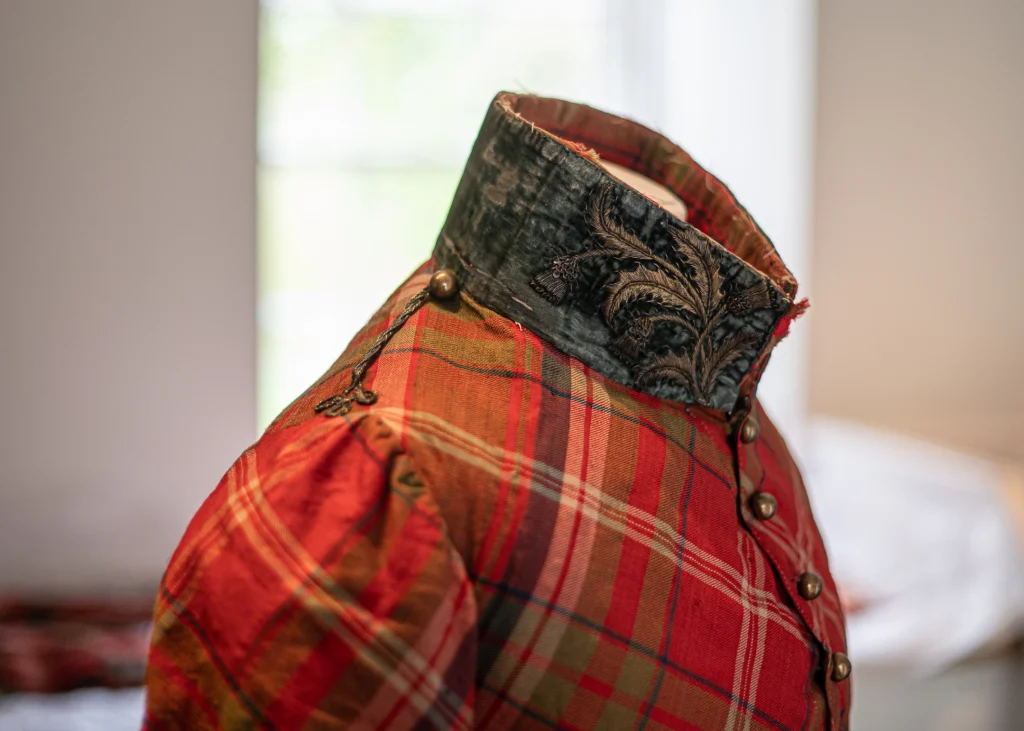
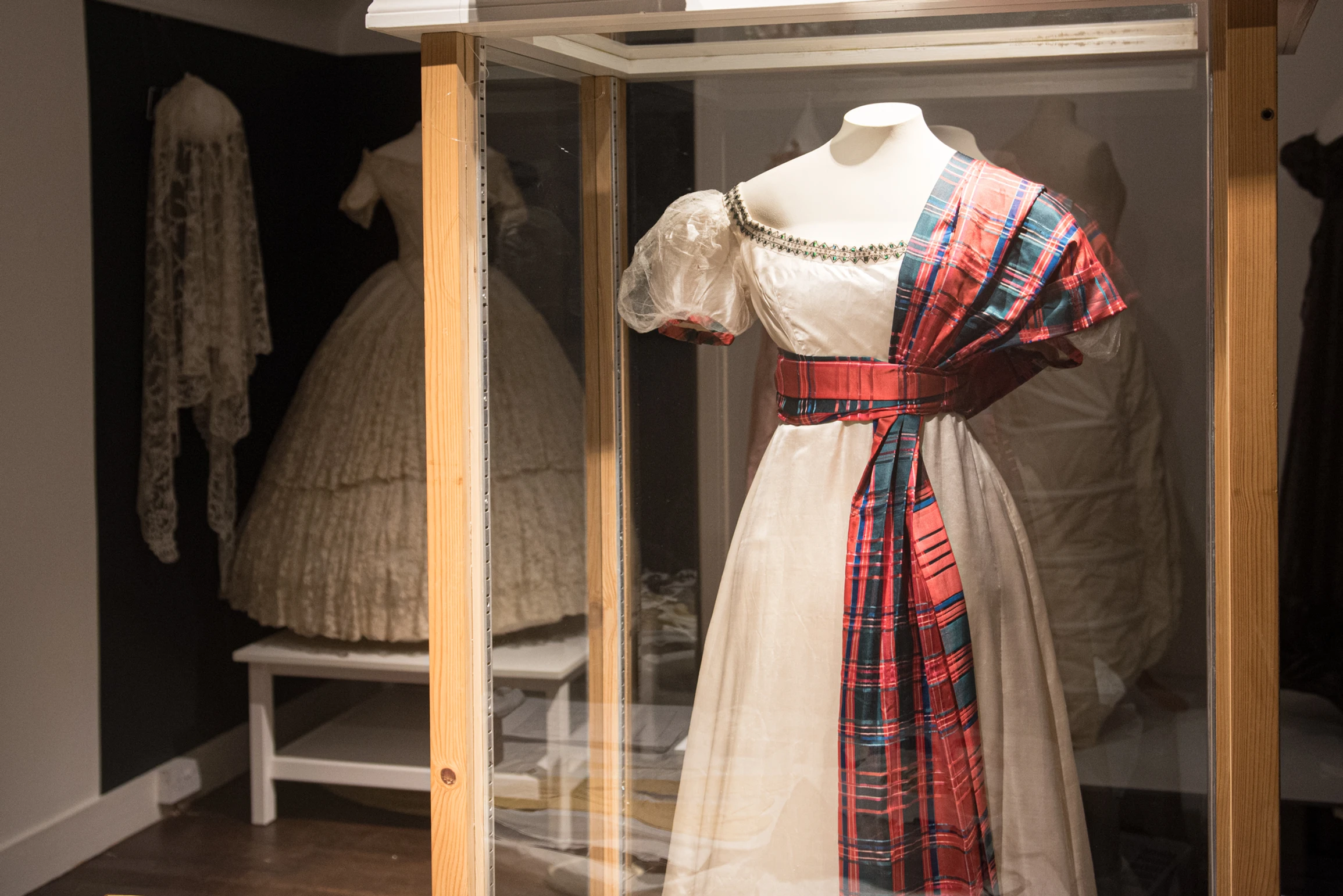
    In 1822, one of the MacDougall’s most famous characters, Admiral John, and his sister, Mary-Jane MacDougall, met King George IV during his famous Scottish visit. In keeping with the writings at the time of Sir Walter Scott, who was stirring the spirit of the Highland Revival, John would have looked every bit the Highland chief in his iconic 5-piece tartan suit, made in around 1819 at the peak of the High Revival. Mary-Jane, beside him, would have looked just as striking wearing one of the prized pieces in our collection: the beetle wing dress.

    This cream dress – featuring a classic high Regency waistline – is embellished with green iridescent beetle wings, which have been embroidered onto a strip of cotton which was then attached to the dress. An extra strip of embroidered cotton remains inside the dress, likely kept in case a replacement was needed, or potentially for another garment, though another was never made.

    Almost all known examples of surviving beetle wing dresses in Britain have had the elytra (beetle wing) embroidery wedded to a fully cotton garment – Mary Jane’s dress of silk-satin being the exception. These dresses were almost certainly all constructed in India until the middle of the nineteenth century, if not even later. The cotton used for most of them was incredibly high-quality Indian muslin, impossible for the English textile industry to rival, even with cotton grown and imported from elsewhere.

    Using the wings of jewel beetles to embellish clothes and jewellery was not a new craze. The process was common across Asia for centuries before Western women took a shine to it, with some literature suggesting that it may have had symbolic meaning in historic practice. The adult ‘Sternocera aequisignata’ – the jewel beetle most commonly used for embroidery – have an average life span of two to three weeks. During this time, they shed the hard, iridescent outer layer of their wings naturally. After they die, their wings are collected and sometimes trimmed before being used for embroidery. Using small, trimmed piece of the wings for embroidery – seen along the neckline of Mary-Jane’s dress – was the traditional way to use them.

    Using the whole wing, as shown around the bottom of the dress, was a very Western way to display beetle wings.

    Elytra embroidery was a way to signify one’s material wealth and fashionable excess, and this dress would have been right at home beside John’s Highland chief costume of the iconic 5-piece suit. Whilst men were being encouraged, however, by the likes of Sir Walter Scott to really lean into the tartan revival, women were still expected to be in more demure dresses. Mary-Jane subtly had the sleeves of her gown tipped with tartan to match her slippers. A tartan sash was found in the MacDougall house, after the dress had been recovered, and stitching on it matched marks on the dress, suggesting they were worn together.

    Photographs: LJF Photography | https://www.ljfphotography.co.uk

    This article was written by our Curatorial Apprentice, Shannen Calderwood.

    Today, Dunollie’s Beetle Wing Dress is carefully stored away to help conserve it for future generations.

  • The Enchantress of the Woods: Dunollie’s Rowan Tree

    The Enchantress of the Woods: Dunollie’s Rowan Tree

    A few feet from the North Wing of our 1745 House, forming part of the border between the driveway and the path to Dunollie Castle, sits an ancient Rowan tree with its striking red berries currently in gorgeous contrast to the green of the trees behind.

    Drenched in folklore, with connections to the Druids and Norse mythology, the continued reputation of this magical tree as a protective symbol reminds us how embedded traditions and stories are in the rich culture of the Scottish Highlands and Islands.

    It is likely that the Rowan tree’s historic reputation began thanks to the bold red of its berries. The colour red has long been associated with powerful protection and life force energy – the colour of blood. Red string was also used to tie crosses made of rowan wood together to form protective talismans which were carried by people, hung above fireplaces or thresholds, or even tied to the tails of cattle to ward off evil spirits. Whilst tying these crosses together one would recite the incantation “rowan tree and red thread, make the witches tine their speed.”

    This mystical tree furthers its reputation as a protective omen through the unusual five-pointed stars – or pentagrams – opposite the stalk of the Rowan tree’s berries. Pentagrams are an ancient symbol of balance and protection against evil forces. It is not just the autumn which brings forth the magic of the Rowan tree, however. When the tree is not displaying its beautiful red berries, it is covered in beautiful white flowers, and would often have been denoted as a Faerie or Goddess tree.

    The Rowan trees proximity to the houses here at Dunollie may not be coincidence, as these trees were believed to provide protection not only when made into talismans but to the dwellings by which it grew, as well as to the inhabitants of the house. This belief in the power of the tree created taboos around harming them or using any part of the tree save the berries. However, there were exceptions. Due to the wood of the Rowan tree being so strong and resilient, it makes excellent walking sticks, spindles, spinning wheels and other tools, believed to contain the energies of protection, strength, and wisdom.

    Druids also considered these trees to be sacred and believed them to be a portal between this world and another, either an entrance or an exit. They made exceptions to the preservation of these trees also, but rather than making tools from the wood they burned the Rowan tree in Beltane bonfires and funeral pyres. Rowan trees are often found near the stone circles of ancient burial sites, believed to have been planted by Druids as another way to protect the spirits of the dead.

    The mystical powers of the Rowan tree are not only famous in the Scottish Highlands. In Norse mythology, Thor was being dragged through the underworld in a fast-flowing river before a Rowan tree arched across, therefore creating something for him to cling to. The myth continues that this was the tree from which the first woman was made, the first man having been made from an ash. Before the Rowan’s berries bloom, it does bear a resemblance to a small ash tree, and pentagrams – a shape already touched on in the Rowan tree’s story – has been known to represent divine femininity.

    The Rowan tree is also present in Greek mythology, where there can be found a story of Hebe, goddess of youth. Hebe gave out ambrosia, the nectar of the gods, from a magical chalice. But when this chalice was taken by demons, the gods sent an eagle to recover it. During the ensuing flight, the eagle shed blood and lost feathers and where each feather and drop of blood fell, a rowan tree sprung up. This legend says that this is why Rowan leaves look like feathers and the berries are blood red. Here at Dunollie we have a story long told of an injured eagle in residence at our abandoned castle… could they have brought the Rowan tree to our grounds?

    The Rowan tree, regardless of how it arrived, thrives here in its perfect climate. They are known to grow well in high-altitude locations – more so than any other tree – and are commonly found in the wild, particularly here in the highlands of Scotland. Mature trees can grow to 15m in height and can live for up to 200 years. Like many trees and plants in our beautiful garden grounds, the Rowan tree is an important provider for wildlife. Its flowers produce pollen and nectar for bees and other insects, while the berries are a rich source of autumn food for birds, especially birds like redstarts which we are known to see a lot of here at Dunollie.

    The berries, as well as feeding birds throughout cold autumn months, are also suitable for human consumption when cooked. Throughout history, wine has been made in the Scottish Highlands using Rowan berries, and Scots also used to make a strong spirit from them. Today, rowan berry jelly is still made in Scotland and traditionally eaten with game.

    If you are at Dunollie in the future, look out for this tree as you walk towards our castle, and enjoy passing by a tree more mystical than any other – an otherworldly portal, a protector, and a provider.

  • Women in Fishing

    Women in Fishing

    A little bit of local history…

    Until the late 1960s, on the corner where High Street and Gibraltar Street meet Argyll Square in Oban, Jeanie MacFarlane could be found selling fish. No matter the weather, she carried fish from the pier in her wooden barrow and sold them to passersby. In her later years, she acquired a van and moved from her corner to park by the pier. She was remembered affectionately in the town for her generous portions and sense of humour.

    MacFarlane is just one woman who was historically considered to comprise the “backbone of the fishing industry”; her predecessors paved the way. While fishing is historically associated with men, women along the coast of Scotland have been integral parts of the industry since the 19th century. In the 1840s, girls and young women began to accompany fishermen on their herring expeditions to keep camp. They baked, cooked, and washed for the crews. While the household duties alone kept the fishermen afloat – both literally and figuratively – the women were also tasked with making and mending nets and baiting the lines with mussels, which they also had to collect.

    By the 1870s, the fishing market was thriving, resulting in women taking on even more prominent roles. Around this time, the crews transitioned to decked boats, as opposed to setting up camp on land. With this change and due to the increase in volume of fish, women’s duties expanded beyond keeping house and they began gutting and packing the herring in teams of three: two women gutted and one woman packed the herring. An experienced gutter could finish 30-60 fish in a minute.

    As the industry bloomed, so did the number of women working, with just under 2,000 herring lassies employed in 1905, a record year. The women were on call from early Monday morning until Saturday night, as the boats arrived at unpredictable times. During their working hours, there was little time for rest, even for food or injured hands. The women’s fingers were bandaged with cotton to prevent cuts, but at the speed they were working, injuries were inevitable. With long hours, sore hands, and little rest, the work was not glamorous, but the workers persevered to get the fish to market.

    In addition to making and mending nets, baiting lines, and gutting and packing, women were also tasked with selling the product. In the early days of the industry, herring lassies sold fish out of a pack on their back. With time, packs turned to barrows, and barrows to vans, evident in Jeanie’s operation in Oban. She maintained the long history of herring lassies in Oban and greater Scotland, while simultaneously evolving past traditions and developing a story of her own. Jeanie MacFarlane is remembered as not only part of the rich history of Oban, but also of women’s prominence in the fishing industry in coastal Scotland.

    These images and documents can be found in the ‘Fishing, Herring-Gutters, Ganseys, Kippers, etc.’ binder in the Dunollie Archives located in the Reading Room. There are many other binders in the Reading Room filled with various aspects of local history which our visitors are welcome to consult.

    This particular piece of research is one of five blog posts put together by Helen Anderson. Helen joined us all the way from Vermont, USA, as recipient of the John S. Carasik scholarship. The scholarship is awarded through the MacDougall McCallum Heritage Foundation, with the goal of sending recipients to Dunollie Museum, Castle and Grounds & the Gaelic Heritage Centre in Lismore to assist with our ongoing projects.